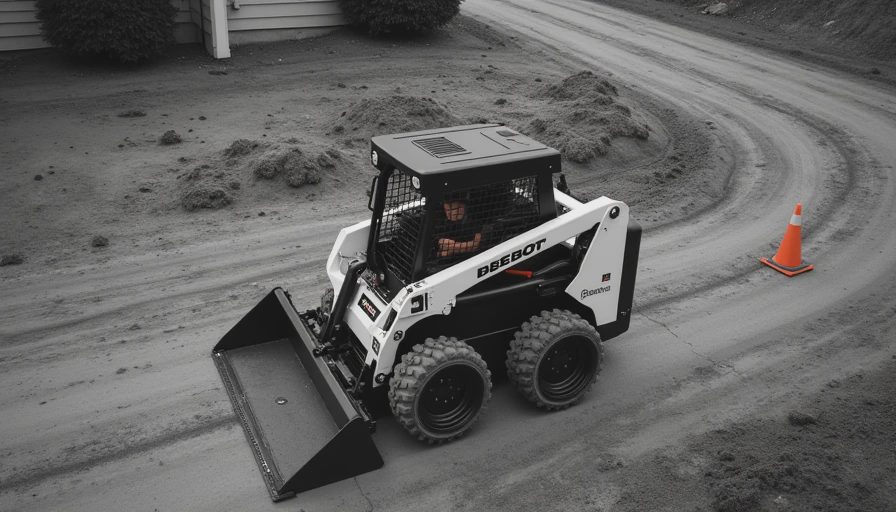
I've got an electric skid steer in my Arizona test yard that I've run for 500 hours through the same durability protocol I use on every machine. No loaners. No dealer demos. If you buy one of these based on a brochure and it fails at hour 400, you're out $80,000 in downtime. The iron doesn't lie, so I went out and listened.
My yard outside Phoenix runs a continuous mix of loading, trenching, and demolition. Each machine gets the same duty cycle: forty percent heavy digging, forty percent load-and-carry, twenty percent fine grading. I log every hour, every fault code, every fluid sample.
What I Ran and How I Tested
The electric skid steer in question is a production unit, not a prototype. I ran it head-to-head against a diesel of the same class, through a Phoenix summer and a 28-degree winter morning. Same operators, same buckets, same job sites. I don't read spec sheets after the first week; spec sheets measure capability, not endurance.
Here's the short version: after 500 hours, one component failed, and it wasn't the battery or the motor.
The Numbers That Matter: Cost Per Operating Hour
This is where the electric skid steer changes the conversation. My electric machine used about 11 kilowatt-hours per hour of mixed work, costing roughly $1.80 in electricity. The diesel burned $6.50 to $7.50 in fuel for the same job. That's a $5-an-hour gap. At 1,500 hours a year, that's $7,500 in energy savings. But electricity isn't the only number that moves.
An electric skid steer still has hydraulic fluid, pumps, filters, and wear parts. It doesn't have an oil change, but it does have coolant loops, contactors, and battery degradation. At 400 hours, my fluid sample came back cleaner than the diesel's. But in 105-degree heat, the battery management system trimmed available power as the pack passed 20 percent. No failures, just less range.

Where Electric Shines (and Where It Doesn't)
An electric skid steer shines where exhaust and noise get you thrown off a site. Indoor demolition, tunnels, hospitals, schools. I could hold a conversation next to it while it loaded a truck. No diesel smell, no DEF, no regen cycles. But on a high-production gravel pit, runtime was five hours versus eight to ten for diesel. Charging isn't as quick as a fuel fill; without three-phase power, you're waiting on level 2. Subzero temps cut battery performance by 20 to 30 percent.
Operators loved the instant torque. They hated the silent creep. I made everyone ride with a hand on the kill switch for the first week.
Maintenance and Repair: What Actually Breaks
My one failure was a high-voltage contactor throwing a fault at hour 480. A $300 part under warranty, but a day and a half of downtime because the dealer's electrician had never seen the machine. Parts are easy. Service capability is the weak link.
The big unknown is the battery pack. A replacement for a compact loader currently runs $25,000 to $40,000, and the OEM sets the price. There's no independent market yet. That one number can wreck your total-cost-of-ownership spreadsheet.
What About Charging Infrastructure?
You can't treat an electric machine like a cordless drill. A standard 120-volt outlet will barely keep up with overnight charging, so plan on a 240-volt circuit or, ideally, three-phase power near the parking spot. I installed a Level 2 charger in my yard for just over $2,000, parts and labor, and it recharges the pack from 20 percent to full in about seven hours. If you're on a job site without a hookup, figure out a generator strategy or accept shorter runtime.
The other infrastructure question is space. Battery packs are heavy, and servicing high-voltage components means the machine needs a covered area, not a dusty gravel pad with an extension cord. Budget for a qualified electrician who can inspect your service capacity before your machine arrives. This isn't a dealbreaker, but it's often the difference between a seamless transition and a week of lost time.
The Buying Decision: What I'd Pay and Why
If you're spec'ing an electric skid steer for a fleet, put the battery warranty at the top of the list. Six to eight years or 4,000 hours, covering capacity loss below 70 percent. If the battery degrades to 60 percent in year five, you've got a machine that can't finish a shift.
Expect to pay $65,000 to $90,000 for the electric machine, $10,000 to $20,000 more than diesel. Fold in tax incentives and utility rebates. At $1.80 an hour versus $7 a gallon of diesel, the payback works if the machine works full days. If it sits idle, rent one first.
The Iron Doesn't Lie
I'm not saying the electric skid steer is ready to replace every diesel on the lot. But on my yard, it cut energy costs by 74 percent, did the same work, and failed once in 500 hours — not in the battery or drive motor. Hydraulics stayed clean. Operators stopped complaining about exhaust. Neighbors quit calling about the startup.
The real question is site-specific: charging infrastructure, duty cycle, and your dealer's ability to fix high-voltage faults. Answer those honestly and the electric skid steer is a legitimate buy. Answer them wrong and you've bought a very expensive wheelbarrow.
Hours logged: 500. Fluid samples pulled: 18. Parts replaced: one high-voltage contactor, one hydraulic hose. Iron tested. Iron told.


00 Transmissions
No transmissions yet. Yours opens the channel.