
The jlg quad track telehandler prototype raises a useful question: would four tracked undercarriages give a telescopic handler enough mobility on soft ground to justify their cost and maintenance? Maybe, but I cannot confirm the prototype’s specifications, production status, or availability. Treat it as an unverified concept, not a machine you can order or a proven solution for a muddy site. There are no independent operating hours, fluid samples, or repair records here to support a durability verdict.
For a contractor facing a purchase decision, the immediate answer is simpler: compare the machine you can actually get, its approved load chart, and its dealer support against the ground conditions you need to cross. A track design may improve flotation, but it does not automatically increase lifting capacity or make an unstable surface safe.
What a quad-track layout could change
A conventional telehandler typically travels on four tires. A quad-track arrangement would use four separate track assemblies rather than four tires. More contact area can reduce average ground pressure for a given machine weight, which is useful when tires sink into soft soil. But contact pressure is not uniform, and the actual result depends on the complete machine, track geometry, load, and ground conditions.
The trade-off is mechanical complexity. Each track assembly introduces components that need inspection and eventual replacement. Depending on its design, those can include belts, rollers, idlers, drive components, and tensioning hardware. Mud, abrasive soil, and debris can turn routine cleanup into real shop time. Turning on firm ground may also put substantial wear into track components and the surface beneath them.
Traction and flotation are different things. A machine that stays on top of soft soil may still slide on wet clay, particularly with a raised load or on a slope. A heavier undercarriage could also offset some of the benefit of its larger footprint. Without measured machine weight and contact area, any ground-pressure number would be a guess.
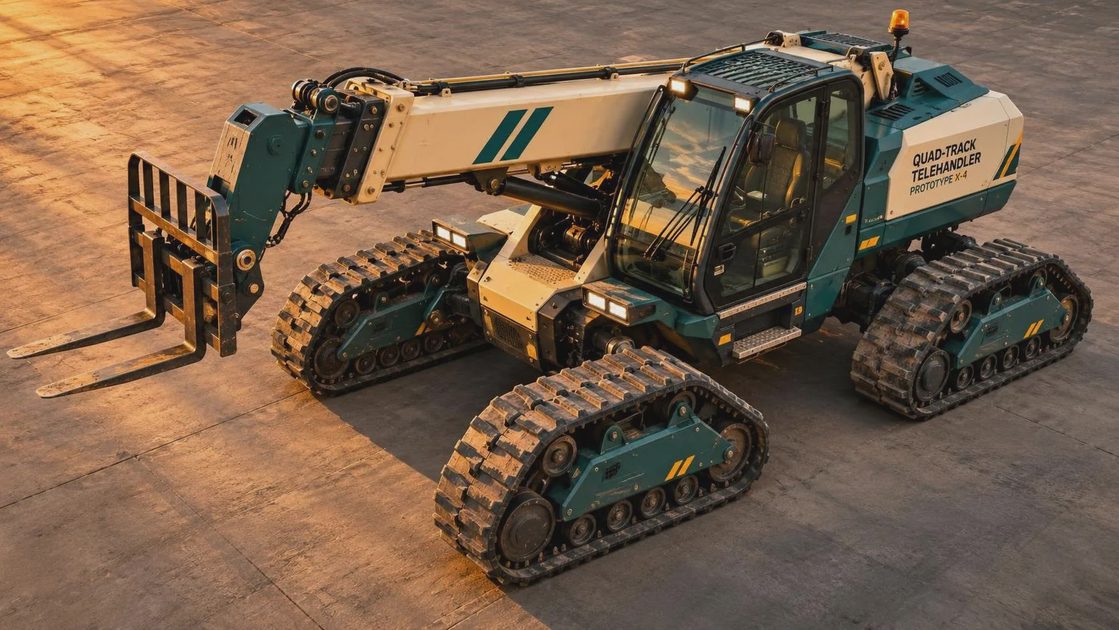
What to ask JLG about the jlg quad track telehandler prototype
Start with the machine’s identity. Ask JLG or an authorized dealer for the exact model or concept designation, whether the configuration was built by JLG or another company, and whether it is a demonstration machine, a production offering, or an aftermarket conversion. A photo or trade-show video alone does not settle any of those questions.
Then request documentation for the exact configuration: operating weight, overall width and height, transport dimensions, approved attachments, and a load chart. Ask whether the chart applies specifically to the track-equipped machine. A chart from a wheeled version should not be assumed valid for a machine with a different undercarriage or weight distribution.
Finally, get the commercial details in writing. Who supplies the track components? Who performs warranty work? Can a local technician replace a damaged belt or roller, and how long are parts expected to take? If the answer is that support is still being developed, that is not necessarily a defect in a prototype. It is a risk the fleet manager needs to price before committing a machine to a schedule.
Read the load chart before looking at flotation
A telehandler’s capacity changes as the boom extends and rises. The number on a machine’s side is not the load it can carry at every reach and height. Use the chart for the specific machine, attachment, and operating configuration, then match it to the weight and center of gravity of the actual load.
Tracks do not cancel out the need for firm, properly prepared ground. The machine must be positioned and leveled as required by its operator’s manual. A track sitting partly over a void, on a buried obstruction, or on a collapsing edge creates a different problem from low bearing pressure on a flat surface. No general ground-pressure figure tells you whether a particular trench edge will hold.
For lifts near excavations, retaining walls, or recently placed fill, have a competent person assess the ground and establish the necessary setback. If the job needs engineered bearing or lift calculations, get them before the machine arrives. The operator needs a workable plan, not an instruction to make a questionable setup work.
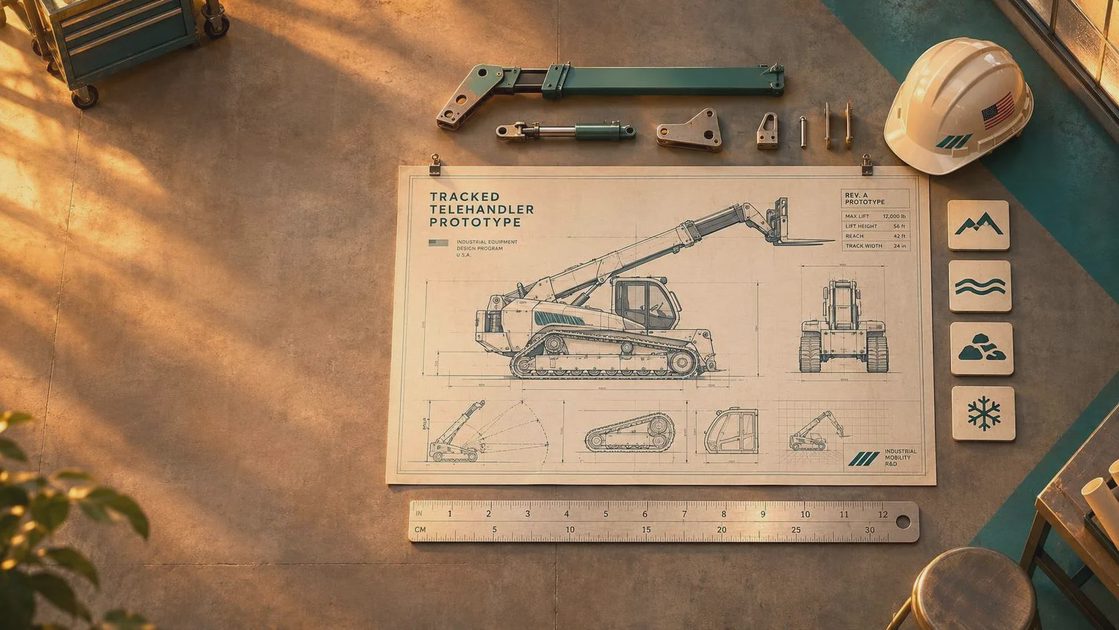
How to evaluate one without buying the brochure
If a machine becomes available for a supervised demonstration, build the trial around the work it must actually do. Use a representative load within the applicable chart, a measured travel route, and the same ground conditions used to judge the alternative. Record whether the route requires repeated turns, reversing, or travel over transitions between soft ground and hard pavement.
Log engine hours at the start and finish. Record fuel added, idle time if available, cleanup time, and any maintenance required during the trial. Inspect track tension and visible undercarriage condition according to the manufacturer’s instructions before and after. Those observations will not prove long-term durability, but they can expose practical issues such as material packing around the tracks or difficult daily access.
A short demonstration cannot establish belt life or cost per operating hour. For that, ask for documented field hours, replacement intervals, parts prices, and labor times from the supplier, and distinguish estimates from completed repairs. Calculate undercarriage cost per hour by dividing the total cost of the relevant parts and labor by the hours those components actually ran. Keep fuel, scheduled service, and downtime separate so the comparison remains useful.
When a different approach makes sense
A wheeled telehandler may be the better tool when most travel is on compacted ground, pavement, or finished surfaces and the soft section can be improved. Mats, properly designed access roads, or a change in material-delivery location may solve the traction problem without adding a specialized undercarriage. Price the ground preparation and removal, not just the rental invoice.
If the work involves sustained travel through poor ground, compare a tracked option against the cost of repeated recovery, delays, and site repair. Also check transport width, trailer capacity, attachment compatibility, and whether the dealer can support the machine where it will work. Those details matter more than an impressive walkaround.
Until the configuration and its support are documented, I would not build a bid around it. The iron doesn't lie, but first you need the iron, the correct chart, and enough working hours to see what the undercarriage costs.


00 Transmissions
No transmissions yet. Yours opens the channel.