
The biggest digger in world is Bagger 293, a bucket-wheel excavator built for Germany's open-pit lignite mines. At roughly 96 meters tall and 225 meters long, and weighing around 14,000 metric tons, it's in a different weight class from the hydraulic excavators most operators call diggers. Those figures are commonly reported approximations, not measurements from my yard. The important distinction: this machine removes material continuously with a rotating wheel; it doesn't fill one bucket, swing, and dump.
Bagger 293 was built for work in Germany's Rhineland lignite mining region. Its size makes sense in a sprawling surface mine with a long working face and a conveyor network. It would make no sense on a highway widening job. Moving it, supporting it, and keeping material flowing are major operations in their own right.
What makes the biggest digger in world so large?
Start with the cutting end. A bucket-wheel excavator carries a large rotating wheel fitted with multiple buckets around its rim. As the wheel turns against the working face, the buckets cut and lift material. That material transfers onto conveyors running through the machine, then onward into the mine's material-handling system.
The wheel is only one part of the assembly. A long boom positions the cutting wheel at the face; another conveyor structure carries material away. A large superstructure supports those loads, while crawler tracks spread the machine's weight and allow it to reposition. Electric power drives the major systems. This is closer to a mobile processing and conveying system than an oversized backhoe.
Published dimensions make the scale easier to picture: approximately 315 feet tall and 738 feet long. Exact figures can vary by source and measurement method, particularly when boom position and attachments enter the discussion. The mass figure is about 15,400 US short tons, not 14,000 US tons; metric tons and short tons aren't interchangeable.
That bulk serves a purpose. Lignite operations can require removal of enormous volumes of overburden, the soil and rock above the coal seam. A bucket-wheel machine can keep cutting and conveying as long as the face, downstream equipment, and maintenance schedule allow it. The theoretical volume on a brochure is not the same thing as the material a mine moves over a shift.
Continuous digging versus a hydraulic excavator
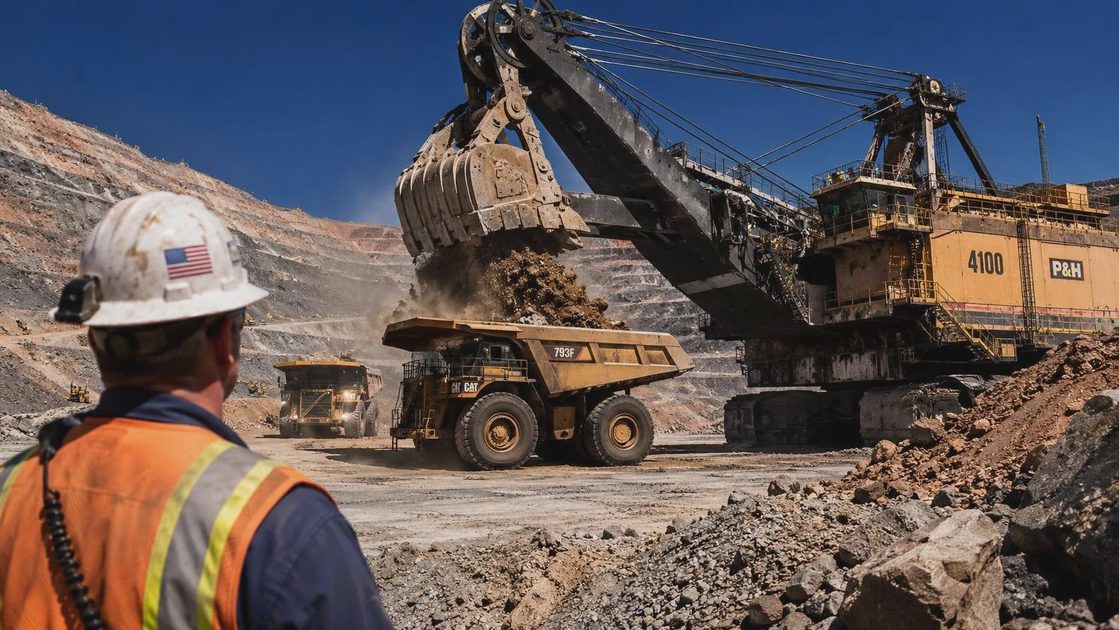
A conventional hydraulic excavator works in cycles: crowd the bucket into the bank, fill it, swing, dump, and return. A bucket-wheel excavator uses a succession of buckets and a conveyor to provide a more continuous flow. That changes the bottleneck. With a hydraulic machine, truck positioning and cycle time matter; with a bucket-wheel system, the condition and capacity of the conveyors downstream matter just as much as the cutting wheel.
The ground matters, too. Bucket-wheel excavators are suited to large, planned deposits with material and mine geometry compatible with continuous cutting. A hydraulic excavator has a different advantage: it can work in tighter areas, change tasks, and load individual trucks. Neither machine is automatically better just because its bucket or wheel is bigger.
Consider a stoppage at the receiving conveyor. The cutting end may be ready to work, but material has nowhere to go. An operator or control system must reduce or stop the feed to avoid a pileup. The machine's potential production is irrelevant until the whole chain is moving again.
How Bagger 293 compares with other giant machines
Bagger 288 is another enormous German bucket-wheel excavator in the same general class. Both are associated with the Rhineland lignite fields, and published accounts sometimes mix their dimensions and operating histories. Check the machine number before attaching a record or photograph to either one. Bagger 293 is commonly identified as the larger of the two by operating mass.
The Caterpillar 6090 hydraulic mining shovel is a more useful comparison for someone familiar with truck-and-shovel mining. It's a giant hydraulic machine, but it works in discrete loading cycles rather than feeding a continuous conveyor through a bucket wheel. Compare it with Bagger 293 by mining method, not just by bucket size.
There's also Big Muskie, a historic dragline excavator that worked in Ohio and was dismantled after its working life. A dragline uses a suspended bucket and cables, not a rotating bucket wheel. It belongs in a conversation about immense earthmoving machines, but different records use different categories: total machine mass, bucket capacity, height, and whether the machine still exists can produce different winners.
What the size figures don't tell you
A headline tonnage won't tell a mine manager what the machine costs per bank cubic yard. For that, you need actual material moved, electrical consumption, maintenance labor, replacement components, and the costs of the connected conveyor system. Ground conditions and the distance material must travel also matter. Without the same boundaries on both sides of a comparison, a cost-per-hour number can mislead.
Availability needs a definition as well. A machine may be mechanically ready while the conveyor line is down, or the conveyor may be ready while the cutting assembly is being serviced. Track both the excavator's availability and the availability of the complete production system. Then separate planned maintenance from unplanned failures so a long scheduled shutdown doesn't get mistaken for a breakdown pattern.
Wear inspection is another system-wide job. Cutting elements and buckets meet the material first, but transfer points, belts, rollers, drives, and structural connections all carry consequences when they deteriorate. The priority is not to guess which component fails first; it's to inspect against the site's maintenance plan and watch for changes in wear, vibration, temperature, and alignment.
Why the record matters
Bagger 293 is the answer when the question is about the largest commonly recognized land-based excavator by mass. It is not a practical benchmark for a contractor choosing a conventional excavator. Its job depends on a mine plan, stable ground, electrical infrastructure, and a material-handling system built around continuous production.
For a fleet manager, the useful lesson is to size the whole operation, not just the digging attachment. For an operator, it's a reminder that the machine at the face is only as productive as the route carrying material away. The iron doesn't lie, but a single record number never tells the whole story.


00 Transmissions
No transmissions yet. Yours opens the channel.