The world's largest excavator is not the kind of machine you haul between highway jobs on a lowboy. It is a moving industrial plant, built to remove entire layers of earth around the clock. That machine is generally identified as Bagger 293, a German bucket-wheel excavator used in open-pit lignite mining. I have not run Bagger 293 for 100 hours, so this is not an Iron Test review. It is a technical teardown of what its published dimensions mean, where the design makes sense, and why comparing it with a 90-ton hydraulic excavator can lead a buyer badly off course.
The machine behind the record
Bagger 293 was completed in the mid-1990s for large-scale surface mining. Published specifications put its operating mass at roughly 14,200 tons. It stands close to 315 feet tall, stretches roughly 738 feet from end to end, and uses a long boom carrying a rotating bucket wheel. Depending on the source and measurement method, overall dimensions are reported slightly differently, but the scale is not in dispute. This machine is taller than many office buildings and longer than two football fields.
The world's largest excavator is often described as a giant excavator, but that label needs an asterisk. Bagger 293 is a bucket-wheel excavator, or BWE. Instead of using a boom, stick, and digging bucket to attack a face one scoop at a time, its wheel carries multiple buckets that continuously cut material. A conveyor system moves the spoil away as the wheel works. That continuous process is the whole point: no truck bed, swing cycle, or repeated loading pause interrupts the production stream.
A conventional hydraulic excavator might carry a 10- to 70-ton operating weight, depending on its class. A large mining shovel can exceed 1,000 tons. Bagger 293 belongs to another category entirely. It is closer to a mobile conveyor terminal with a cutting head than to a Komatsu PC490 or Caterpillar 395 scaled up until the bolts are bigger.
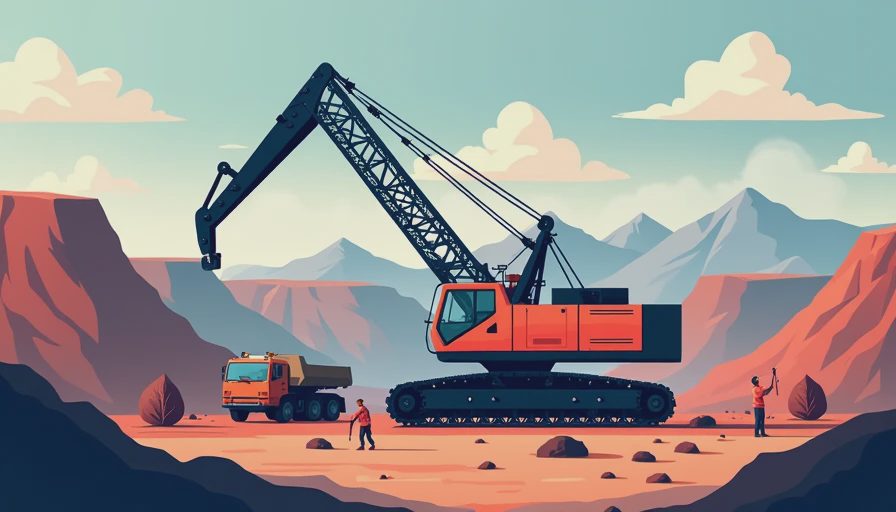
How the world's largest excavator moves material
The cutting wheel is the first thing people notice, but the material-handling system matters more than the silhouette. Published figures commonly credit Bagger 293 with a theoretical excavation rate around 12,000 cubic meters per hour. That number is not a promise that 12,000 cubic meters of saleable material will appear every hour. It is a design-capacity figure under suitable geology, feed conditions, conveyor availability, and operating discipline.
The world's largest excavator works through a coordinated chain. The wheel cuts overburden or lignite. Material drops onto onboard conveyors, transfers to fixed or mobile conveyor sections, and moves away from the working face. Crawler assemblies reposition the machine, while slewing and boom movement place the wheel against the next cut. Those crawlers are not fast. A machine this size advances at a walking pace or slower, because every movement involves enormous loads, ground-pressure calculations, and electrical coordination.
Its installed electrical power is commonly listed at roughly 16,500 kilowatts. That is not comparable to engine horsepower in a diesel excavator. Electric motors provide controlled torque across the cutting, conveyor, slewing, and travel systems. The advantage is sustained production without burning diesel in dozens of haul trucks. The tradeoff is dependence on a serious electrical distribution network. Cut the power, and the machine is not merely idle; an entire mining sequence can stall.
Why size does not automatically win
The world's largest excavator makes economic sense only when the deposit, mine plan, and infrastructure support it. A BWE needs long production runs and relatively predictable, soft material. It is not the tool for scattered utility trenches, blasted granite, residential basements, or a road project that moves to a new mile marker every week.
Geology is the deciding factor. Hard, abrasive rock can damage buckets, cutting teeth, wheel structure, conveyors, and drive components. Moisture and clay can plug transfer points. Uneven ground creates alignment problems. A hydraulic excavator can change tools, reposition quickly, and load trucks from several angles. Bagger 293 delivers unmatched continuous volume in the right seam, but it has little flexibility when the ground stops cooperating.
That distinction matters to fleet managers. A machine producing enormous hourly volume is not necessarily producing the lowest cost per ton. You have to include power supply, conveyor construction, maintenance access, specialized technicians, spare drives, structural inspections, and the cost of an interruption. If a 40-ton excavator goes down, one crew loses production. If a bucket-wheel system goes down, the connected material stream may lose production from the wheel to the stacker.

What contractors should learn from the world's largest excavator
The world's largest excavator offers a useful lesson for anyone buying heavy equipment: match the machine to the production system, not the other way around. A contractor moving 500,000 cubic yards over a short project might be better served by several conventional excavators, articulated trucks, and a dozer. That package costs more in fuel and operators, but it can be redeployed and repaired with widely available parts.
For a mine with a stable seam and decades of reserves, the calculation changes. Continuous excavation can reduce truck traffic, loading cycles, and diesel exposure. It can also create a cleaner production rhythm. However, the supporting equipment becomes part of the purchase decision. Conveyors, transfer towers, power substations, crawler paths, drainage, and access platforms are not optional accessories. They are the machine's working environment.
When I inspect a used hydraulic excavator, I look at oil cleanliness, swing-bearing play, pump case-drain flow, final-drive metal, and the repair history behind the hour meter. A bucket-wheel excavator demands the same discipline at a much larger scale: sample gear oils, inspect welds, measure bearing wear, examine bucket attachments, trend motor temperatures, and record conveyor alignment. A clean paint job tells you almost nothing. Fluid and vibration data tell you whether the iron is healthy.
Record holder versus practical workhorse
The world's largest excavator wins the size contest, but records are not purchase recommendations. For most North American contractors, a 50- to 100-ton hydraulic excavator is far more useful because it can dig, load, lift, grade, and move between projects. Models from Caterpillar, Komatsu, Hitachi, Volvo, and Liebherr occupy different niches, yet all can be supported through established dealer and parts networks.
Bagger 293 is valuable as an engineering case study. It shows what happens when designers optimize for continuous extraction instead of mobility and versatility. The machine's strength is not that it can do every job. Its strength is that, under the right conditions, it can keep cutting and conveying at a scale no truck-and-shovel fleet can easily imitate.
The three-sentence diagnostic is simple. Here is the symptom: people compare a record-size BWE with a production excavator by looking only at dimensions. Here is the root cause: they are solving different material-handling problems. Here is what to do about it: calculate geology, annual volume, infrastructure, downtime exposure, and resale support before choosing iron.
The world's largest excavator is impressive because every component serves one narrow purpose: move a vast amount of material continuously. That is also its limitation. The iron does not lie, and this iron says specialization wins only when the entire job is specialized.
Hours logged: not personally tested. Fluid samples pulled: none by this reviewer. Parts replaced: none. Iron studied. Iron told.

00 Transmissions
No transmissions yet. Yours opens the channel.