A bulldozer john deere 1010 can be an honest little crawler or a green-painted repair bill. The difference is rarely the decal on the hood. It is the condition of the undercarriage, the engine, the steering clutches, and the hydraulic system when you arrive with a flashlight and a cold start plan. I have inspected enough old iron to know that a five-minute auction walkaround proves almost nothing. The iron doesn't lie, but sellers and paint sometimes do.
This is a buyer’s guide, not a field durability review. I have not logged 100 hours on one specific 1010 for this article, so I will not pretend a demo-day impression is test data. Instead, I will show you where these machines commonly consume money and how to turn an asking price into a defensible total cost.
Start with the machine’s identity
The 1010 name covers an older John Deere crawler tractor family, and configuration matters. You may encounter a standard crawler, a loader conversion, different blade arrangements, agricultural adaptations, or a machine with replacement components from another Deere model. Locate the serial plate before discussing value. Photograph the plate, engine tag, transmission casting, hydraulic pump, and blade control arrangement.
Do not rely on a listing title that says bulldozer john deere 1010. Confirm what is actually present. The correct service manual and parts references depend on serial number and component configuration. A machine missing its original engine can still work, but the swap affects cooling, mounts, wiring, resale, and parts support. Ask for maintenance records, previous repair invoices, and the reason it was parked. “Ran when parked” is a storage statement, not a performance statement.
At an auction, budget for transport before bidding. A non-running crawler may require a lowboy, winch, loading crew, and several hours of recovery work. That can turn a $4,000 purchase into a $7,000 arrival at your yard.

The undercarriage sets the price
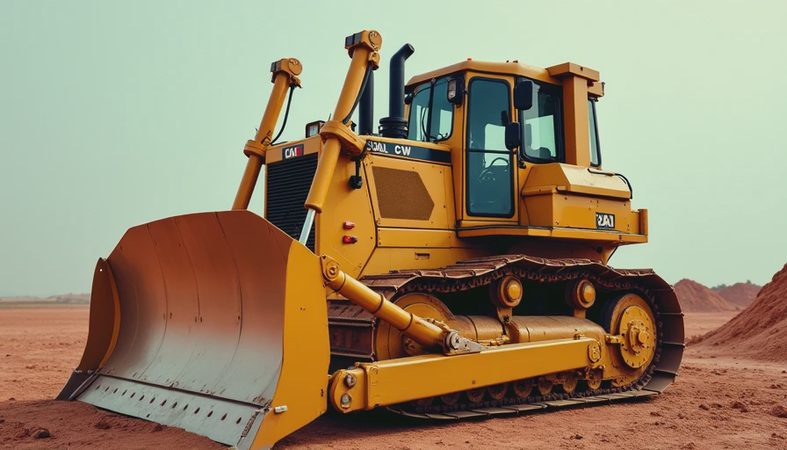
On an old crawler, the undercarriage is usually the largest single cost center. Look at rail height, link wear, bushing condition, sprocket tooth shape, roller flange wear, and idler position. A track adjuster pushed almost completely forward can indicate stretched chains or worn components. Shiny contact surfaces and scalloped sprocket teeth tell a different story than normal polished wear.
Measure rather than guessing. A qualified undercarriage inspection uses manufacturer dimensions and percentage-worn calculations. If those references are unavailable, get clear photographs and have a crawler specialist estimate remaining life. A partial undercarriage job can easily run $3,000 to $8,000 in parts and labor on an older machine; replacing rails, rollers, idlers, and sprockets can exceed the purchase price.
Check final-drive housings for cracks, oil leaks, loose bolts, and abnormal heat discoloration. Pull the drain plugs if the seller permits it. Metallic paste on a magnetic plug is a warning. Water, milky oil, or a strong burnt smell deserves a hard pause, not a hopeful discount.
Engine and cooling-system checks
A cold start tells more than a warm engine idling beside a trailer. Touch the block, radiator tank, and exhaust manifold before starting. Watch for excessive white smoke after warm-up, persistent blue smoke, hard cranking, uneven firing, and blow-by from the crankcase breather. A little haze from an old diesel is not an automatic failure. Continuous smoke paired with low power and rising oil consumption is a repair plan.
Inspect the radiator core for packed debris, repaired tanks, missing fins, and evidence of coolant loss. Old crawlers often work in dust, and a plugged radiator can make a healthy engine look sick. Confirm fan-belt tension, hose condition, oil pressure behavior, and coolant level after the machine reaches operating temperature. A cooling-system repair may cost a few hundred dollars for hoses and a belt, while radiator or engine work can move into the $2,000 to $7,000 range quickly.
A bulldozer john deere 1010 that starts instantly from cold, carries stable oil pressure, and does not push coolant into the overflow deserves a closer look. It still needs a load test.

Steering, transmission, and blade operation
Crawler steering clutches and brakes are not optional details. Drive forward in both directions, make gradual turns, then test each steering side under light load. A machine that will not turn until the lever is pulled fully back may have adjustment, clutch, brake, or contamination problems. If one side drags while traveling straight, do not assume the operator simply needs practice.
Listen for grinding during gear selection and clunks during direction changes. Test every available gear without forcing the lever. A tired bulldozer john deere 1010 may still move across flat ground while hiding a transmission problem that appears only under pushing load. Ask whether the transmission oil level is correct and whether the machine has been operated with water contamination.
Cycle the blade slowly and then under load. Look for cylinder rod pitting, oil appearing at gland seals, loose pivot pins, cracked push arms, and sloppy trunnions. A hydraulic leak that leaves one drop per minute is not the same as a cylinder that empties its reservoir in an afternoon. Record the symptom, find the source, and price the actual repair.
Parts, manuals, and repair economics
Before buying a bulldozer john deere 1010, call two parts sources with the serial number. Ask about engine overhaul kits, clutch components, hydraulic seals, track parts, filters, and hard-to-find electrical pieces. Some service items remain manageable through aftermarket suppliers, salvage yards, and agricultural equipment networks. That does not guarantee every internal transmission or final-drive component will be available at a reasonable price.
A practical budget might look like this: $5,000 for a running but cosmetically rough example, $2,000 to $4,000 for initial fluids, hoses, filters, batteries, and wiring, and another $3,000 reserve for overlooked repairs. If the undercarriage is beyond 50 percent wear and the machine needs steering-clutch work, the economics change fast. Your own labor can reduce cash expense, but it does not make parts free or downtime invisible.
Compare the machine with a running Deere, Caterpillar D4, or International crawler in the same price range. A less original machine with documented repairs can be a better tool than a clean-looking project.
My inspection sequence before bidding
I use a simple order that prevents paint from influencing the decision. First, verify identity and ownership paperwork. Second, inspect oil, coolant, and final-drive levels. Third, perform a cold start. Fourth, check steering and transmission behavior. Fifth, operate the blade under load. Sixth, inspect for leaks after shutdown. Finally, write down every defect with a parts-and-labor estimate.
Bring a flashlight, inspection mirror, magnet, infrared thermometer, paper towels, a tire gauge for support equipment, and a small container for fluid samples where permitted. Do not crawl under a raised blade or rely on hydraulic pressure to support equipment. If the seller will not allow a cold start or basic fluid inspection, price the machine as non-running.
A bulldozer john deere 1010 makes sense for a hands-on owner who has a shop, realistic expectations, and a job suited to an older crawler’s size. It makes less sense for a contractor who needs guaranteed production next Monday. Buy the iron you can repair, not the story attached to it.
Hours logged on this specific review machine: 0. Fluid samples pulled: 0. Parts replaced: 0. Iron inspected through the buyer’s lens. The iron doesn't lie.

00 Transmissions
No transmissions yet. Yours opens the channel.