
Saturday morning. 6:45 AM. The test yard is still cool, which in Arizona means it's only 85 degrees. I'm drinking coffee on the tailgate of my truck when Cody walks out of the house in his steel-toe boots—the ones I bought him two years ago that he's already outgrown. He's got his phone in his pocket, which I told him to leave inside. He didn't.
"Ready?" I ask.
"Yeah," he says, like it's no big deal. But I see him looking at the CAT 320. It's the machine he's been watching me run for two years. The machine he's asked to drive about fifty times. Today's the day I finally say yes.
The First Fifteen Minutes Are a Disaster
He climbs into the cab. I stand on the track, leaning through the door. I show him the joysticks. Left stick: swing and stick. Right stick: boom and bucket. Travel pedals on the floor. That's it. Five controls. Simple.
It's not simple.
He starts the engine. It idles. I tell him to raise the boom—slowly. He pulls the right stick back, and the boom goes up. Then it keeps going. He pulls too hard, the boom maxes out, and the relief valve squeals.
"Too much," I say. "Ease off."
He tries again. This time the boom drifts down too fast and the bucket hits the dirt with a thud I can feel through my boots.
I climb into the cab and sit in the jump seat. "Forget the boom for a minute. Just swing. Left stick, left. Easy."
He swings the house left. Then right. Then left again. Overcorrects. The cab jerks.
"Slow," I say. "The machine moves slower than your hands. You have to let it catch up."
He nods. But his hands are still jerking.
What Cody Does Wrong
He does everything wrong—which is exactly what I expected. But watching him, I start to see patterns. They're the same patterns I see in every new operator I've ever trained. The mistakes aren't random. They're predictable.
He overcorrects constantly. He moves the joystick too far, then yanks it back the other way. The machine lurches. He lurches with it. It looks like a kid learning to drive a stick shift. There's no smoothness. Every input is an emergency.
He doesn't anticipate. He moves the boom, then waits to see what happens. By the time he reacts, the machine has already moved past where he wanted it. He's playing catch-up the whole time.
He looks down at the controls. His eyes go to his hands instead of the work area. He's thinking about the stick, not the bucket. That means he's always a half-second behind.
He grips too tight. White knuckles. His forearms are tense. The tighter he grips, the more he overcorrects. It's a feedback loop.
What I Start to Remember
I trained a thousand techs and operators at Caterpillar. But I haven't trained someone from zero in years. Watching Cody, I remember things I'd forgotten.
The cab is intimidating. It's a confined space with a dozen switches, two joysticks, pedals, and a screen that flashes warnings. Every new operator feels overwhelmed. The solution isn't to explain everything at once. It's to reduce the variables.
Muscle memory takes time. A smooth operator isn't thinking about the controls. The hands do the work while the brain watches the bucket. But that connection takes hours to build. A 14-year-old brain builds it faster than an adult's—but it still takes hours.
Patience can't be faked. I catch myself wanting to say "just do it like this" and take the controls. But that's not teaching. That's showing off. If I want him to learn, I have to let him make the mistakes.
Hour Four: The First Good Cycle
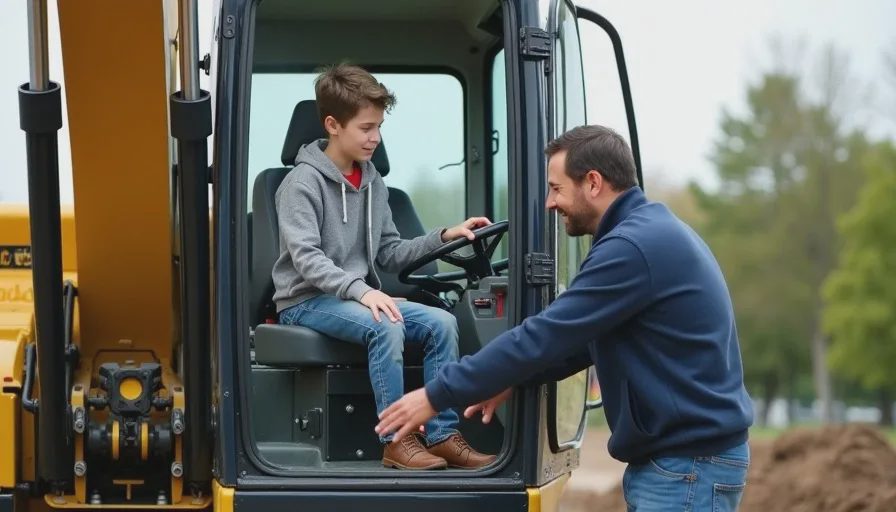
Around hour four, something clicks.
He's been digging a trench along the test loop. He raises the boom, curls the bucket, swings left, dumps. It's been clunky—jerky and inefficient. But on this cycle, the swing is smooth. He rolls the stick instead of yanking it. The boom comes up early, so it's ready when he starts the swing. The bucket opens just before the dump point.
The whole thing takes maybe six seconds. But it's the smoothest six seconds I've seen from him all day.
"Did you feel that?" I ask.
"Yeah," he says. "I think I did."
"What did you do different?"
He thinks for a second. "I stopped looking at my hands."
That's it. That's the whole thing. He stopped thinking about the joysticks and started watching the bucket. His hands figured out the rest.
Hour Seven: The Second Click
By hour seven, he's running the machine almost independently. I'm not in the cab anymore. I'm standing fifty feet away, watching through the cab window.
He's digging a corner. He has to reposition the machine. He uses the travel pedals to turn—left track forward, right track reverse—and the machine spins in its own footprint. He swings the boom clear, repositions, sets the tracks, and continues the trench.
I didn't tell him how to do that. He figured it out.
When he shuts down for a water break, I ask him how he knew to spin the machine like that.
"Felt right," he says. "The tracks just needed to be pointed that way."
That's the second click. He's not thinking about controls. He's thinking about what the machine needs to do. The controls are the middleman, and he's starting to bypass them.
What Cody Teaches Me About Operator Training
I've trained adult operators on machines worth half a million dollars. They're nervous. They're careful. They don't make big mistakes because they're afraid of breaking something.
Cody isn't afraid. He's just trying to make the machine do what he wants. When he fails, he tries again. When he succeeds, he tries to do it better. There's no fear of the machine. There's just curiosity.
That tells me something I've been ignoring for years: fear is the enemy of learning.
Adult operators learn slower because they're scared. They overthink. They hesitate. They second-guess. A 14-year-old doesn't do any of that. He moves the stick, sees what happens, adjusts. No fear. Just feedback.
The best operators I've ever trained were the ones who weren't afraid to make mistakes. The worst were the ones who were terrified of being wrong.
I'm going to change how I train adults. Less lecture. More seat time. Let them make the mistakes. Let them feel the machine. The lecture comes after they've got the feel, not before.
The End of the Day
At 5:00 PM, the sun is starting to drop behind the mountains. Cody has run the excavator for about ten hours over two days. He's tired. His forearms are sore. He has dust in his hair and grease on his jeans.
I ask him if he wants to stop.
"One more," he says. "I want to get this corner right."
He climbs back in. Starts the engine. Runs the cycle—boom, curl, swing, dump. Smooth. Clean. Efficient.
He shuts it down and climbs out.
"Good?" I ask.
"Good," he says. "I think I've got it."
He heads up to the house. He leaves his phone on the tailgate. Forgot it. Didn't even notice.

00 Transmissions
No transmissions yet. Yours opens the channel.