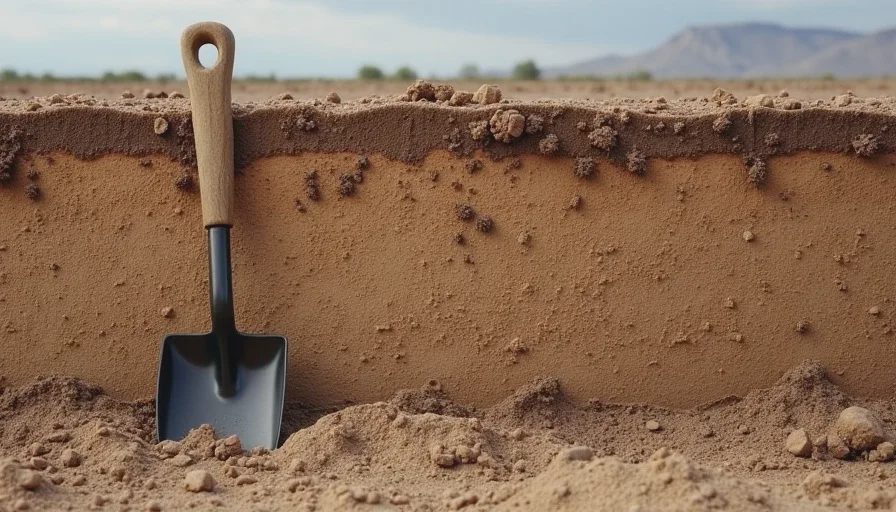
I've measured undercarriage wear on the same machine in three different states. Same model. Same operator. Same maintenance schedule. The only difference was the dirt.
In Georgia clay, that machine's track chains lasted 4,200 hours. In Colorado decomposed granite, 3,800. In Arizona hardpan—the sun-baked, caliche-laced soil that covers half this state—I pulled those same chains at 1,900 hours. Less than half the life.
This isn't bad luck. It's geology. And understanding why hardpan kills undercarriages is the difference between a track replacement at 2,000 hours and one at 4,000.
What Hardpan Actually Is
Hardpan isn't just "hard dirt." It's a specific soil condition common in arid climates where evaporation outpaces rainfall. Over decades, minerals—mostly calcium carbonate and silica—leach down into the soil and then precipitate out, cementing sand and clay particles into a layer that's dense enough to stop a pickaxe.
The technical term is caliche. In Arizona, it starts about six to eighteen inches below the surface and can extend down five feet or more. When it's dry, it's almost as hard as concrete. When it's wet, it's still hard—it just gets sticky.
Here's what that means for an undercarriage: the track chain is constantly running against an abrasive surface that doesn't give. There's no cushion. No deformation. No soft layer that absorbs some of the impact. Every pin and bushing is grinding directly against a material with a Mohs hardness around 4—hard enough to scratch a copper coin, soft enough to embed itself in every moving joint.
What the Data Shows
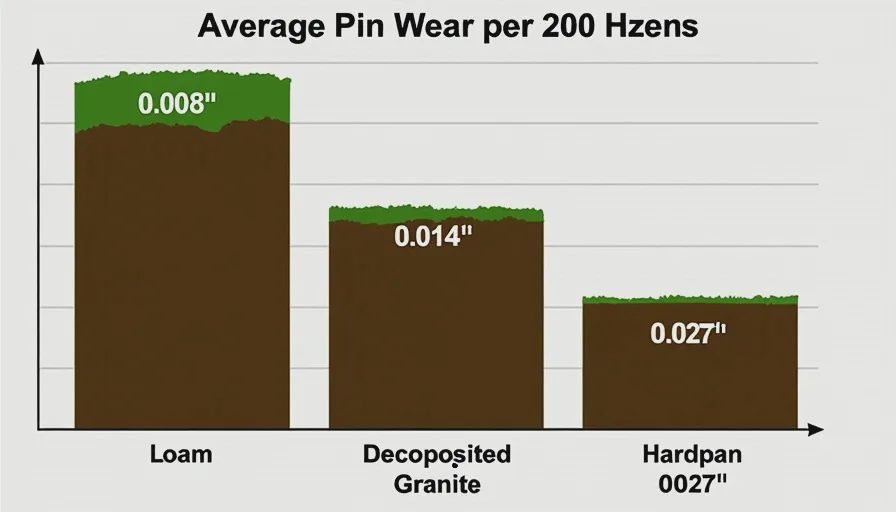
I've been measuring undercarriage wear on my test yard since 2018. Every machine gets a full undercarriage measurement before and after each 200-hour test cycle. I measure pin wear, bushing wear, link height, track sag, and sprocket tooth thickness. Here's what the numbers look like:
Average pin wear per 200 hours:
Soil Type | Pin Wear (inches) | Bushing Wear (inches) |
|---|---|---|
Loam / sandy soil | 0.008 | 0.012 |
Decomposed granite | 0.014 | 0.019 |
Arizona hardpan | 0.027 | 0.035 |
That's more than double the pin wear in hardpan compared to loam. And bushing wear—the thing that determines when you need to turn or replace your chains—is nearly triple.
On a 20-ton excavator, those numbers translate to a track chain life of roughly 4,000 hours in loam, 2,200 hours in hardpan, and 1,800 hours in high-silica hardpan like what you find around the copper mines. The difference in cost is about $18,000 per machine, per undercarriage set, every 2,000 operating hours.
Why Hardpan Is Worse Than Rock
You'd think rock would be worse. It's not.
The problem with hardpan is that it's abrasive and sticky. Rock is hard, but track chains ride over rock with relatively low sliding friction—they grip and move. Hardpan acts like sandpaper that doesn't wear out. The caliche particles are angular, not rounded, so they cut into metal rather than rolling over it. And because hardpan compacts so densely, those particles don't wash away or get displaced. They stay in the track joints, grinding every time the chain articulates.
I've pulled pins from machines that ran 1,500 hours in hardpan and found the pin surfaces mirror-polished. That's not a good thing. That polish is the caliche acting as lapping compound, grinding away the surface hardening and exposing softer steel underneath. Once that happens, wear accelerates exponentially.
What This Means for Maintenance
If you're running equipment in the desert Southwest, you're not going to change the dirt. But you can change how you maintain against it.
Shorten your measurement intervals. I recommend undercarriage measurements every 250 hours in hardpan, not every 500. The wear curve is steeper—you need to catch it earlier to make informed decisions about turning chains or replacing components.
Adjust your track tension. Loose tracks wear faster in abrasive conditions because the chain slaps and grinds against the sprocket and idler. In hardpan, I run track tension at the tight end of the manufacturer's specification—not over-tight, but not loose enough to let the chain oscillate. This reduces the grinding action at the sprocket engagement point.
Monitor bushing rotation. Some undercarriage manufacturers offer rotating bushings that can be turned to expose unworn surfaces. In hardpan, that rotation interval drops from every 1,000 hours to every 600. If you wait until 1,000, the bushing is already past its useful life.
Consider a dedicated hardpan undercarriage. Several manufacturers offer "severe duty" or "high-wear" undercarriage packages with deeper case hardening and thicker bushings. They cost 15–20 percent more upfront. In hardpan, they last 40–50 percent longer. The math works out in your favor—but you have to spec it from the start. You can't add it later.
Arizona hardpan isn't just tough on tracks. It's the single most destructive operating condition you'll encounter outside of actual mining applications. It wears pins twice as fast. It grinds bushings into oval shapes. It turns a 4,000-hour undercarriage into a 2,000-hour liability.
The iron doesn't lie—and neither does the dirt. Measure. Adjust. Plan for shorter replacement cycles. Or move your equipment to Georgia. I hear the clay is easier on chains.
00 Transmissions
No transmissions yet. Yours opens the channel.